
Seven Protocols, Billions of Cells: Fall 2026 Parkinson’s Research Update

By Jan Shultis, Ph.D.
Earlier this year, a peer-reviewed piece on an FDA-authorized clinical trial in Parkinson’s Disease was published by Wiley. Currently screening is underway for another Parkinson’s Disease trial, the seventh using Hope Bio’s cells to date, while detailed analysis continues on a completed Phase II trial that announced positive topline results. As we head into the fourth quarter of 2026, let’s take a look at what the Wiley piece says in plain language, where the published trial fits in with the others, what we hope to see in the current trial, and what we’re learning about treatment periodicity, prevention of symptom progression, and study design across the research suite.

About Parkinson’s Disease
Parkinson’s, the second most common neurodegenerative disorder in the American population, affects more than one million people in the United States, with a projected global patient population of 25 million by 2050. As many as 90,000 individuals are newly diagnosed each year, or one person every eight minutes. The Parkinson’s Foundation estimates the combined direct and indirect cost of Parkinson’s, including treatment, social security payments and lost income, at nearly $83 billion per year in the U.S. Medications alone cost patients an average of $2,500 a year, and therapeutic surgery can cost up to $100,000 per person. Parkinson’s affects more men than women, showing no preference related to ethnicity, race or socioeconomic status.
Research in Parkinson’s Disease often includes quantitative and patient-reported outcomes in areas such as motor symptoms and quality of life, including but not limited to improvements in fatigue, pain and muscle spasms, anxiety and depression, cognition, mobility, sleep, social functioning, and medication doses.
Parkinson’s Research using Hope Bio’s Cells
The seven protocols previously mentioned using Hope Biosciences’ adipose-derived mesenchymal stem cells (HB-adMSCs) constitute the most comprehensive research suite in this condition in adult cellular therapeutics to date of which we are aware. The protocols include patients aged mid-30’s to early 90’s, men and women, of varied demographic and socioeconomic backgrounds. Two protocols are randomized, double-blind, placebo-controlled Phase II clinical trials exploring early to moderate disease progression. Two protocols are Intermediate Size Expanded Access to extend treatment to the placebo groups in those clinical trials, following positive results. One protocol is Intermediate Size Expanded Access for patients aged older than 76 years. Two are individual Expanded Access protocols for patients (one male, one female) with severe, progressed Parkinson’s Disease. All protocols were developed and executed by Hope Biosciences Research Foundation.
The research suite is also noteworthy for inclusion of both allogeneic (donor) and autologous (the patient’s own) treatments. By executing multiple clinical trials, HBRF became the first research organization in the U.S. to conduct simultaneous trials examining effects of administering the patient’s own cells (autologous) and donor cells (allogeneic) on the same disease condition. Two protocols utilize allogeneic stem cells, while the other five protocols rely on autologous stem cells. All treatments were given intravenously, at a dose of 200 million HB-adMSCs. With the exception of some treatments in the first individual Expanded Access case, for an individual often bedridden due to her symptoms, all treatments were administered on-site at HBRF in Sugar Land, Texas.
The first protocol, an individual Expanded Access case, was authorized by FDA in August 2019. The seventh protocol is screening at the time of this writing (September 2026), with patient treatment to begin soon. Cumulatively, these protocols represent 134 patients receiving 959 treatments (including the protocol currently screening, which includes 27 patients receiving 10 infusions each).
To date, HBRF has published three pieces in peer-reviewed journals on Parkinson’s research using Hope Bio’s cells, including a case study on the first Individual Access protocol in Frontiers in Neurology (2023), results of the Intermediate Size Expanded Access protocol for patients aged 76 and older in Cytotherapy (2024), and the most recently published Wiley article on the first Phase II clinical trial (2026).
What the Wiley piece found
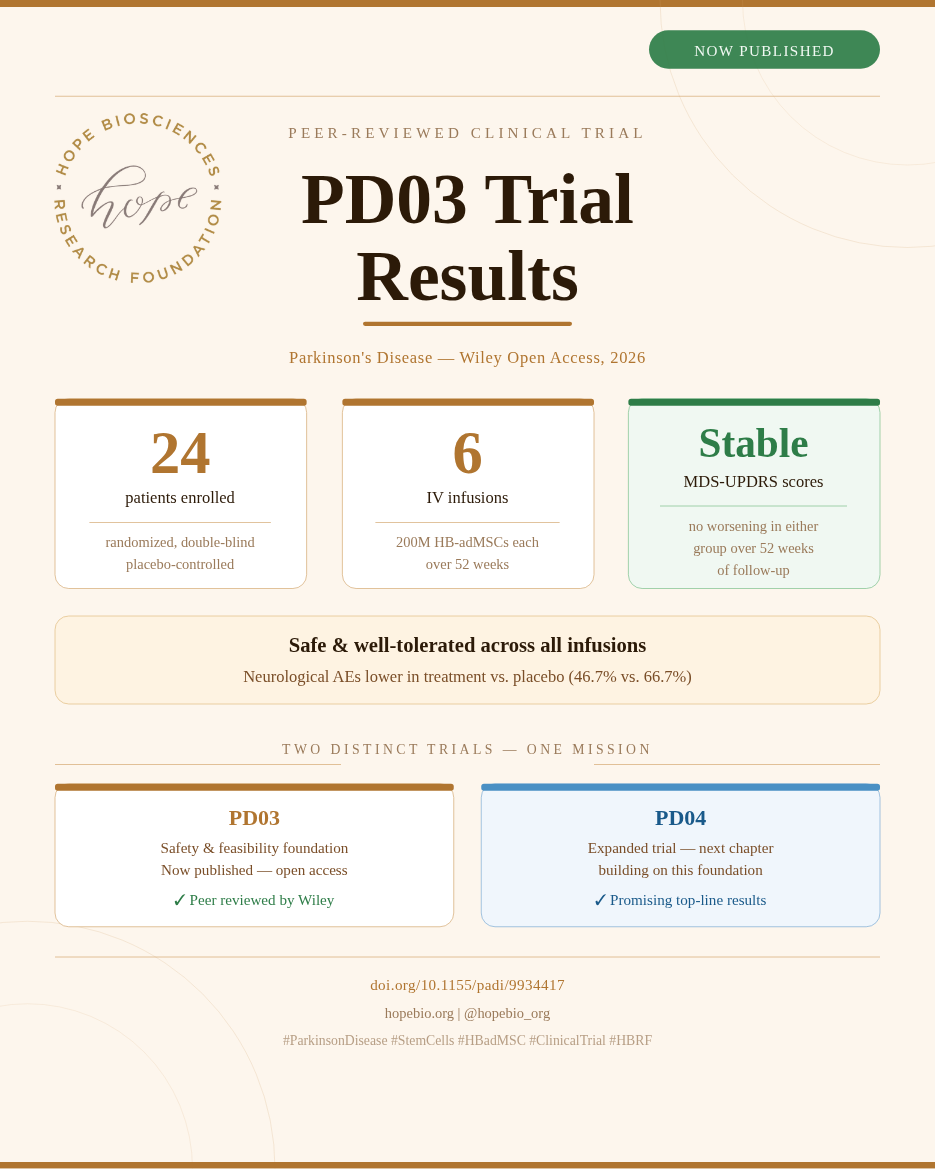
The Wiley article, published in May 2026, shares insights from the first Phase II clinical trial conducted using Hope Bio’s cells. This 24-patient trial administered six infusions of 200 million HB-adMSCs; the first three infusions were given monthly, and the last three infusions were spaced two months apart. In the randomized, double-blind design fifteen patients received treatment, and nine received a saline placebo.
The small, carefully controlled early-stage clinical trial found that the investigational therapeutic was safe and well-tolerated, aligning with previous research and reinforcing the potential of MSC-based therapies in treating neurodegenerative diseases like PD. Trial findings also note stability in disease progression among the patient population, though it stops short of drawing a direct link between the investigational product and patient stability due to small patient pool size. Halting disease progression is a tangible positive experiential result, though difficult to quantify and include in scientific publications in a data-driven way.
Want to learn more about the clinical trial design process? Check out this recent episode of Stem Cell Revolution for comprehensive discussion about what to consider when interpreting results:
What we’re learning about our therapeutics
Considering all seven protocols in Parkinson’s Disease, we can draw the following conclusions at this time, among others:
HB-adMSCs are safe and well-tolerated in individuals suffering from Parkinson’s Disease. Diverse patient populations consistently tolerate treatments of 200 million HB-adMSCs safely and well, at varied periodicities, with no drug-related adverse events.
Patients treated with HB-adMSCs can experience statistically significant improvements in motor function, reduction of Parkinson’s symptoms, and improved quality of life. Since completion of the trial presented in the Wiley piece, clinical research site HBRF has announced positive top-line results of the second Phase II clinical trial previously mentioned, evaluating Hope Biosciences’ allogeneic HB-adMSCs for patients with early to moderate Parkinson’s. This trial included a larger population pool of 60 patients, 30 in the treatment group and 30 in the placebo group. The study found clinically significant changes in motor function, using both the patient-reported Motor Experiences of Daily Living (MDS-UPDRS Part II) and clinician-rated Motor Function (MDS-UPDRS Part III). In-depth analysis is currently in progress, as of this writing.
Consistent, repeated treatment may be the most promising path forward for sustained enhancement in motor function for individuals living with Parkinson’s Disease. Though publication is recent, the Wiley trial concluded several years ago (2024). Since then, HBRF has leveraged results of the Wiley trial and other protocols completed in the interim to continually refine study design and dosing timelines. Among other key lessons from the published trial, Hope Bio concluded that waiting two months between treatments is far less efficacious than more frequent treatments. In the four protocols that followed the Wiley trial, periodicity increased to monthly, then every two weeks to initiate treatment followed by monthly infusions. Meta analysis (i.e., looking across multiple protocols for data and conclusions) is forthcoming on this and other trends.
Protocol design must continue to be refined. Degenerative diseases of any kind share similar difficulties in study design, including but not limited to:
Accounting for reasonably expected variables of aging outside of the diagnosed disease
Projecting rate of disease progression during the entire arc of research development, including factors outside of the manufacturer’s control, such as time for regulatory authorization
Establishing a patient population with satisfactorily similar disease states at time of research enrollment and similar rate of progression, to compare their results in meaningful ways. For example, in the Wiley trial, the treatment group had indications of a somewhat greater disease burden. Double-blind randomization means that no one can predict which patients will end up in which group, so the further progressed disease state in the treatment group emphasizes the importance of careful, refined patient screening.
Balancing the subjective nature of patient reporting through inclusion of more objective data-gathering mechanisms that are vital for evaluating therapeutic benefit. The Wiley trial, for example, found divergent results between the clinician rating and the patient-reported MDS-UPDRS Part II. Parkinson’s Disease, in particular, has a well-documented “nocebo” effect; that is, a tendency for patients to report no or negative change even in the face of overwhelmingly positive biomarker and/or changes observed by others.
Allogeneic therapies constitute a promising path toward increasing access. The trial that announced positive topline results is allogeneic. Allogeneic therapies, with their dramatically reduced costs for manufacturing stem cells to a comparable safety profile, represent a potentially powerful way for reducing fiscal barriers to cell therapy access in the future. Allogeneic therapies also create an opportunity to treat individuals with certain disease histories, such as syphilis or certain forms of hepatitis, whose cells cannot be safely stored due to high risk of contamination. From the manufacturer’s perspective, at Hope Biosciences there is no difference in quality of patient experience between the allogeneic and autologous cellular therapies. Cells are cultured and cared for to the same high standard and regulated the same way, and stem cell donors themselves are carefully screened and selected.
What’s ahead
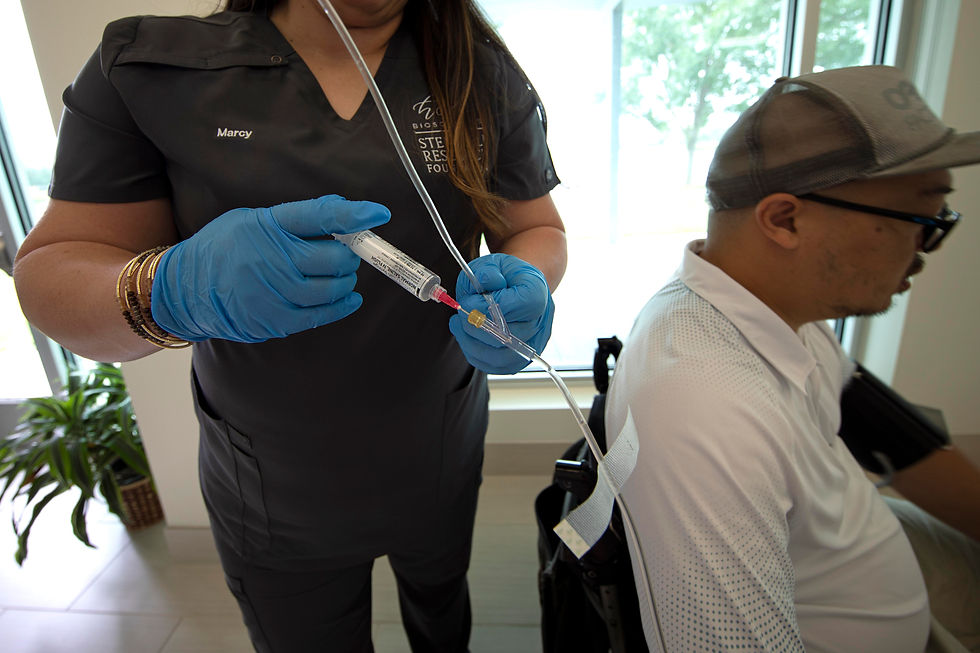
At the time of this writing, the seventh protocol using HB-adMSCs is screening patients at HBRF. In this 27-patient Intermediate Size Expanded Access protocol, the placebo group from the trial that announced positive topline results will receive 10 infusions of 200 million cells (the first four infusions are biweekly, the remaining six are monthly). Protocol design advancements include the addition of a wearable biometric tracker that will aid in real-time data collection for the duration of the study, allowing researchers greater insight into patient response between clinical visits and follow-ups.
With encouraging results from multiple protocols in hand, Hope Biosciences believes our proprietary HB-adMSCs are a meaningful therapeutic option, and looks forward to advancing to a Phase III confirmatory trial. More to come!


Comments